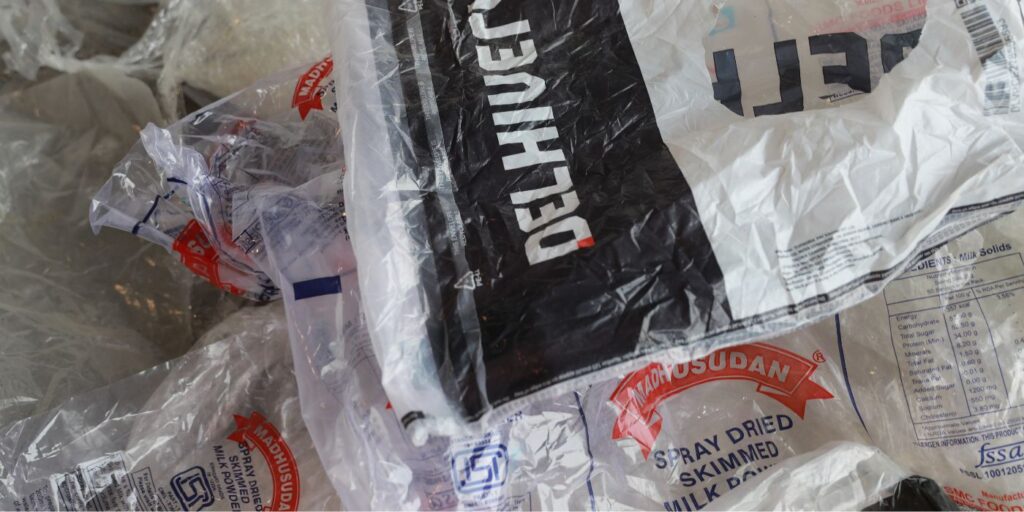
Not all plastic waste entering a recycling facility has the same characteristics. A collection stream can contain different polymers, colours, labels, adhesives, food residue, moisture, metals and other unwanted materials. What happens to these materials before recycling has a direct influence on the quality of the granules produced at the end of the process.
This is why plastic waste segregation is more than a waste-handling activity. For recyclers and manufacturers, it is one of the first quality-control steps in producing reliable recycled plastic granules.
Input waste vs output quality
The quality of recycled material starts with the quality of the incoming feedstock. If plastic waste is poorly sorted, contaminants and different polymer types can enter the same recycling stream.
These differences may eventually appear in the finished granules as inconsistent colour, gels, black specks, irregular material behaviour or variations between production lots.
Post-consumer waste presents a particular challenge. Unlike post-industrial scrap, it may have already been exposed to food, liquids, sunlight and different environmental conditions. It can also contain labels, adhesives and mixed materials. As a result, producing consistent post-consumer recycled granules requires stronger sorting, cleaning and quality-control practices.
For recyclers of India, this relationship between incoming waste and finished material quality is especially important when recycled polymers are intended to return to industrial manufacturing.
Why polymer sorting matters
Different plastics cannot simply be treated as one uniform material stream. PE, PP, PET, PVC and other polymers have different physical and processing characteristics.
Polymer sorting therefore aims to isolate the required resin from other plastics and non-plastic materials before further processing. Depending on the recycling operation, sorting can involve manual inspection, near-infrared identification, density separation and magnetic systems for removing metals.
Even a relatively small amount of an unwanted polymer can affect processing. Mixed polymers can behave differently during melting and may result in gels, specks or other defects in the final recycled material.
Better polymer separation gives the recycling process a more predictable feedstock to work with and improves the possibility of producing granules with consistent characteristics.
Contamination can travel through the recycling process
Contamination does not disappear simply because plastic waste has been shredded or melted.
Labels, adhesive residue, food waste, dirt, metals, moisture and unwanted polymers can all create problems if they are not adequately removed. Washing and cleaning help remove surface contamination, while filtration during extrusion provides another layer of control.
Moisture is also important. Wet plastic flakes entering an extruder can lead to steam, foaming and surface defects. This is why drying and moisture control form an important part of recycled plastic processing.
For waste management companies in India, effective segregation at the collection and sorting stages can therefore support downstream recyclers by providing cleaner and more clearly separated material streams.
Colour segregation affects consistency
Colour is another important consideration when plastic waste is being separated.
Natural or uncoloured feedstock offers greater flexibility because it can later be compounded to meet different colour requirements. Mixed-colour waste, on the other hand, limits that flexibility and can create colour variation in the resulting granules.
Poor colour segregation may consequently lead to visible differences between production lots. For manufacturers purchasing recycled material, this becomes particularly relevant when colour consistency forms part of the product specification.
Colour segregation should therefore happen as early as practical rather than relying entirely on downstream processing to correct variations.
Effect on MFI and consistency
Melt Flow Index, or MFI, is an important quality indicator for recycled polymers because it shows how a material flows under specified heat and pressure conditions. MFI helps manufacturers assess whether a recycled polymer has suitable flow characteristics for a particular processing application.
However, plastic waste collected from different products may contain different resin grades, additives and materials with varying processing histories. Even when the waste belongs to the same polymer family, its melt flow properties may differ.
When these materials are mixed without adequate control, the MFI of the resulting granules can vary from one production lot to another. Such variation can affect processing conditions, cycle times and finished-product quality for the manufacturer using the recycled resin.
Consistent segregation, feedstock inspection and testing therefore help reduce unnecessary variation in the final material.
Producing quality PCR granules
Producing dependable PCR plastic is not determined by a single step at the end of the recycling line. Quality control begins when the incoming waste is received.
The material must first be identified and assessed for contamination. Polymer and colour segregation then help create cleaner streams, followed by washing, shredding, drying, extrusion, filtration and pelletising. Quality checks such as MFI, density, moisture, pellet appearance and other relevant tests can then be used to assess the final output.
Research into industrial sorting of post-consumer plastic waste also highlights the importance of identifying and characterising polymer fractions before mechanical recycling. Better knowledge of the incoming material can support more controlled recycling processes and improve the usability of recycled polymers.
For manufacturers, the value of recycled plastic granules ultimately depends on whether they can perform consistently during production. That consistency begins much earlier than pelletisation. It begins with how carefully the plastic waste is segregated, cleaned and controlled before it reaches the extruder.
Good segregation does not merely improve waste recovery. It helps turn a mixed waste stream into a more predictable industrial raw material.